
Prior to the 1st-century CE, 22 scrolls were recognized as authoritative scripture among our people. See Josephus, Against Apion, 1.1.8. The first five were composed by Mashah (Moses) and 13 by prophets who succeeded him. These are arranged as follows: Ya’ohshai (Joshua), Yashai-Ya’oh (Isaiah), Yaram-Ya’oh-Lamentations (Jeremiah-Lamentations), Danay’al (Daniel), and Ya’oh-khazak-al (Ezekiel) were grouped into one scroll. The historical writings of Roth (Ruth), Shapataym (Judges), Shamo’al-Kings (Samuel-Kings), Chronicles, and Ghazar’a/Nakham-Ya’oh (Ezra-Nehemiah) were grouped into one scroll. Zachar-Ya’oh (Zechariah) and Khag-Ya’oh (Hagai) were prophets at the same time so their writings are one scroll. Then we have eleven more prophetical writings by Hoshai (Hosea), Maycha (Micah), Ya’oh-nah (Jonah), Ya’oh-al (Joel), Malach-Ya’oh (Malachi), Ghamos (Amos), Khabakok (Habbakok), Nakhom (Nahum), Ghabad-Ya’oh (Obadiah), and Tsapan-Ya’oh (Zephaniah). That’s 18 scrolls total. The remaining four scrolls are songs to Alah’aym and principles for daily life: i.e. Mazmor (Psalms), Mashlay (Proverbs), Sapar Sabaybath Ma’arath (The Book of Revolutions of the Luminaries), and Ay’ob (Job).
The Book of the Revolutions of the Luminaries is otherwise known as the “Astronomical Book” found in 1 Enoch 72-82. It is a book with its own title and thus separate from the other writings attributed to Khanokh (Enoch). Unlike the other writings which are of mythical and legendary character and therefore pseudo, this book is wholly scientific and simply transmits knowledge of the workings of the 364-day calendar established since the creation of man. Although the Patriarch Khanokh from the pre-flood age is the source of the material a much later prophet would have been responsible for the composition as we have it today. All of these books were composed from the time of Mashah in the 15th century BCE to the reign of the Persian King Artaxerxes I (465-424 BCE).
By the 1st-century CE the abayonaym community recognized two books authored by them in their native language: i.e. Mathath-Ya’oh (Matthew) and Khazon (The Revelation). It must be stressed here that the originals in Ghabaray (Hebrew) are not to be confused with their more popular Hellenized remixes. The standard Greek book of Matthew and the Greek book of Revelation are paganized versions modified to promote the idolatry of Jesus Christ and thus agree with the doctrines of Pauline Christianity. These Hellenized versions are rejected.
Sapar YA’OH (the Book of YA’OH) we are commanded to seek out, as per the order given in Yashai-Ya’oh (Isaiah) 34:16, is the Thorah that Mashah wrote and only those supplementary books of the prophets that meet the criteria that the prophet Mashah laid down in the Thorah. A book must not contradict anything that Mashah wrote. It must not subtract from, nor add to, the laws that Mashah wrote. It must not alter but repeat and echo what Mashah wrote. It must also follow the example of Mashah by invoking the name YA’OH or quote YA’OH’s words verbatim. If a book does not meet these standards it has no place in the Sapar YA’OH next to the holy Thorah.
THORAH (law, instruction)
The five books of the prophet Mashah (Moses). This is THE most holiest of all books and the foundation and rule of our faith. Nothing is allowed to contradict, change, add to, or subtract from anything that is written in the Thorah, ever. Unlike the Jewish Torah scrolls which contain known mistakes (many of which are noted by the medieval Masorete scribes in the margins of the various Masoretic manuscripts), our manuscript has removed these mistakes. It is a restored text for Ya’oh-shar-al by Ya’oh-shar-al utilizing a comparative analysis of all of the extant textual witnesses.
The Ghabaray Thorah is completely written in the same ancient script that is attested on artifacts of genuine Ya’ohsharalay (“Israelite”) manufacture. The Phoenician-Canaanite script is often confused with the paleo “Israelite” script but they are actually different.
Words in the Ghabaray Thorah are separated not by spaces but by word-divider dots as seen on inscribed artifacts unearthed in the holy land which date to the pre-exilic period.
For the Ghabaray text, I have meticulously consulted and compared the standard Chumash of the traditional Mikraos Gedolos editions against the Dead Sea Scrolls; the Greek Septuagint (LXX); the Samaritan Pentateuch; and also excerpts of the Thorah contained in writings of the first century Hebrew historian Josephus.
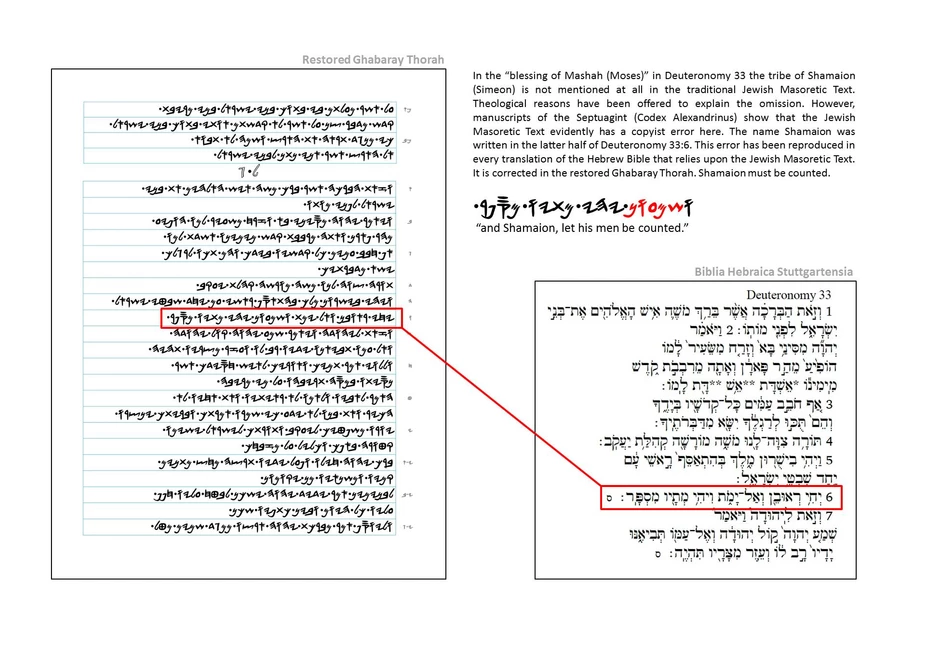
The Ghabaray Thorah is a “restored” text which corrects spelling errors and other mistakes which have crept into the manuscripts of the traditional Jewish Masoretic Hebrew Text over the centuries. Modern editions of the Hebrew Bible include information about the qere (“[what is] read”) and ketiv (“[what is] written”), but the problems are not limited to qere and ketiv. For example, in the “blessing of Mashah” in Deuteronomy 33 the tribe of Shamaion (Simeon) is not mentioned at all in the traditional Jewish Masoretic Text. Theological reasons have been offered to explain this omission. However, manuscripts of the Septuagint (Codex Alexandrinus) show that the Jewish Masoretic Text evidently has a copyist error here. The name Shamaion was written in the latter half of Deuteronomy 33:6. This error has been reproduced in every translation of the Hebrew Bible that relies upon the Jewish Masoretic Text:
- “Let Reuben live, and not die; and let not his men be few” (1611 KJV).
- This error is finally corrected in the restored Ghabaray Thorah:
- “Live Raoban and do not die; and Shamaion, let his men be counted.”
Shamaion must be counted!
FREE SHIPPING
THORAH – Hardcover Laminated: $275.00 USD = 16.6K Php
*Delivery to all locations in the Philippines is usually 2-3 weeks.
PAYMENT METHODS:
We accept PayPal: Conkim23@gmail.com.
We accept GCash: 0996-732-1476
We accept Coins.ph: 0949-840-6212
We accept Bitcoin: bc1q62tc9wclv3dzcp2curarwvu6qnkgpng5gl8tkk.

Please send a copy of your payment transaction to: yaohdah@gmail.com. Once received a tracking number will be sent to your email address.